


Teaching Children to Think, Not Copy, in the Age of AI
- Jun 21
- 4 min read
Updated: Jun 29
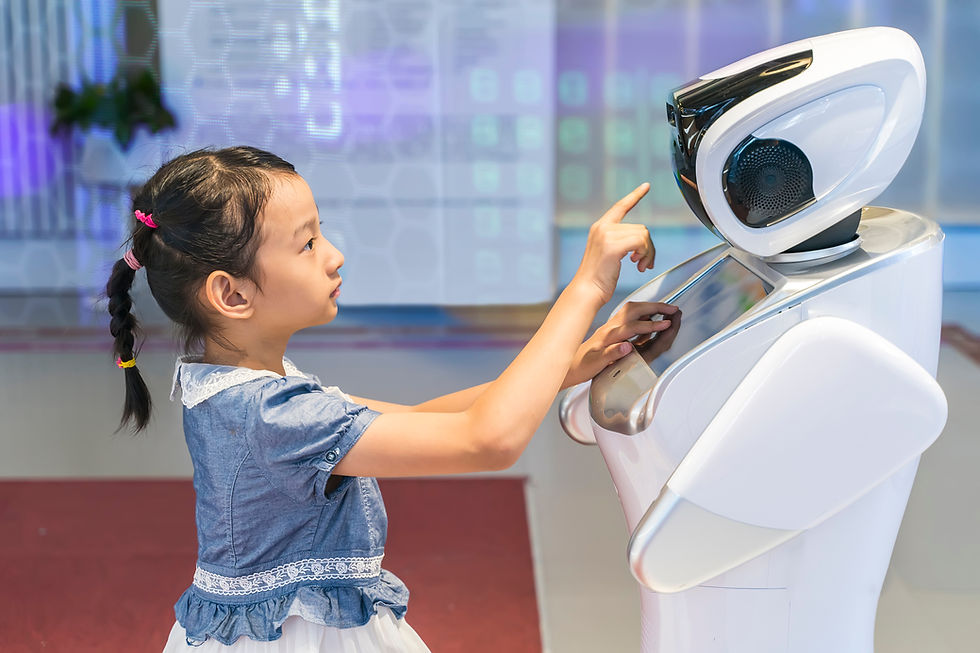
AI Is Already in the Classroom
Artificial Intelligence has become part of everyday life. Whether we are writing emails, researching information, planning holidays, or generating ideas, tools such as ChatGPT are increasingly woven into how we work and learn.
Children are no exception.
Many young people are already using AI to help with homework, essays, and creative writing. There is no denying that these tools can save time and increase productivity. The reality is simple: AI is here to stay. Rather than telling children not to use it, we need to teach them how to use it responsibly and effectively.
A Question Raised by an Eleven-Year-Old Writer
Recently, after one of our creative writing sessions, co-mentor, Sarah Mussi and I found ourselves discussing a writing piece submitted by an eleven-year-old student. The writing was impressive.The descriptions were vivid, the dialogue flowed naturally, and the piece demonstrated strong use of ‘showing instead of telling.’ As we read it, we wondered whether AI had been used to improve the draft. Interestingly, that wasn't our biggest concern. What interested us more was whether the child understood the techniques that made the writing so effective.
Could they explain why a particular description worked?
Did they understand how dialogue revealed character?
Would they be able to apply these techniques independently in their next story?
Those questions matter far more than whether AI was involved.
The Real Risk Isn't AI
Much of the discussion around AI focuses on whether children should use it. I believe that is the wrong question. The real issue is whether children are learning while they use it. If a child submits a flawless piece of writing but cannot explain how it was constructed, very little learning has taken place. The danger is not AI itself. The danger is mistaking polished output for genuine understanding. As educators, parents, mentors, and authors, our responsibility is to ensure that AI supports learning rather than replacing it.
Understanding How AI Generates Text
Many children see AI as an expert that knows the answer. In reality, AI works very differently.
It predicts patterns based on enormous amounts of existing text. It can create writing that is grammatically correct, coherent, and well structured, but it does not think, feel, or draw upon personal experiences. As a result, AI-generated writing can often feel generic. It may be technically strong, but it lacks the personal memories, emotions, observations, author’s unique voice and perspectives that make great writing memorable. Helping children understand this distinction is an important first step.
Can we Challenge the Bot?
Activities that could help bridge the gap between understanding and copying is by showing children how they can Challenge these Bots.
The concept is simple. They may Ask ChatGPT to write a story based on a prompt.
Using the same text generated by AI , children re-write their own version of the same story adding their personal experiences, feelings and ideas.
Next, they compare the two and question:
Which story feels more authentic?
Which character feels more believable?
Which descriptions are more memorable?
Which story creates a stronger emotional connection?
What can the human writer do that AI cannot?
The discussion that follows is often more valuable than the stories themselves. Children begin to recognise that while AI can generate competent writing, originality often comes from imagination, experience, and personal insight. Instead of seeing AI generated texts as something to copy, they begin to see it as something they can improve upon.
Turning AI Into a Tutor
Another important shift is teaching children to use AI as a tutor rather than a ghostwriter.
Before asking AI to improve a piece of writing, children could highlight the AI generated text such as sentences, descriptions, dialogues that they liked and ask questions like:
Why is this sentence effective?
What is ‘showing instead of telling’?
Can you explain this technique to me?
Can you identify examples of this technique in my writing?
In this role, AI becomes a learning companion. The focus moves from generating answers to understanding them.
Helping Children Find Their Own Voice
One of the greatest strengths of writing is that it allows us to express who we are.
AI cannot replicate that. It has never felt nervous before a performance. It has never celebrated a personal achievement. It has never experienced real friendship, loss, excitement, disappointment, or joy. Children have their experiences, emotions, and perspectives that give their writing meaning and authenticity. Our role is to help them recognise the value of those experiences and encourage them to bring them into their work.
Measuring Learning Differently
Perhaps we need to rethink how we measure success in the age of AI. Instead of asking:
‘Did you use ChatGPT?’
We might ask:
What did you learn from using ChatGPT?
Did it help you understand a new writing technique?
Did it give you ideas you hadn't considered?
Did it challenge you to think differently?
Did it help you improve your own work?
These are the questions that matter.
The Future of Writing
The future is unlikely to be a choice between AI and human creativity.
Instead, it will belong to those who can combine technology with curiosity, critical thinking, imagination, and judgement. AI can generate words. But it cannot replace a child's unique voice.
As educators, parents, and mentors, our challenge is not to stop children from using AI. Our challenge is to teach them how to use it in a way that strengthens their understanding, develops their skills, and helps them become more confident thinkers. Perhaps the most important lesson we can teach young writers is this:
Don't let the AI do your thinking.
Use the AI to enhance your understanding.
Should there be writing programmes that teach children to use AI as a tutor or peer: someone they can discuss ideas with, ask better questions, receive constructive feedback from, and learn the nuances of writing, while keeping their own voice, imagination, and creativity at the heart of their work?
Would you like to see such programmes introduced in schools?
By Monica Sood
Author
Publisher- Author In Me Publishing
Curator & Director - AIM Literary Festival


Comments